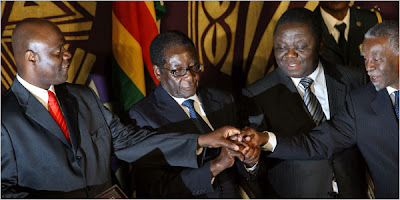
• Farm Invasions Intensify As South Africa Signs Agreement With Mugabe

    Zimbabwean white farmer Tom Bayley is taunted by singing and jeering ZANU PF supporters at his farm as he rode to an abandoned house to use as a shelter. Farms in Chegutu, which is in Mugabe's home province, have seen an upsurge in invasions and intimidation since Friday, when South Africa signed an agreement with Harare to protect the investments of its citizens in Zimbabwe.


    Harare, Zimbabwe, 29 November 2009


    Just as news arrives that South African and Zimbabwe have signed a new Bi-lateral Investment Promotion and Protection Agreement which expressly excludes all farms currently under dispute and/or invaded, we learn that farm invasions have taken a new intensity in Mugabe's home province, around the town of Chegutu.


    The BIPPA was signed on Friday despite court applications by Agricultural pressure groups in South Africa.


    Just as it was being signed, at least three farms in the Chegutu area were being invaded afresh. One of them, Umvovo Farm, owned by Thomas Beattie, first got invaded in August and the Zimbabwean courts put an end to that effort.


    But since Friday, the original invaders have come back with a vengeance. The Beatties have now finally left their home, paving the way for the invasion to be completed. They have been there for 30 years.


    The siege continues at Rainbow's End Farm, owned by members of the Beattie family, as well as Wakefield Farm.


    To understand this, you have to appreciate the psychology behind the invasions, especially from ZANU PF. The party does not want white farmers in Zimbabwe to have any hope. They want to deny them even that emotion.


    You will recall that just after the launch of the Inclusive Government, another wave of high-profile invasions took place and the issue was discussed in Cabinet, with ZANU PF cabinet ministers saying it had to be demonstrated to white farmers that Morgan Tsvangirai's presence in government corridors did not mean that the Land Reform Program would be reversed. There were accusations that some of the farmers who had lost their farms had gone back to their properties "boasting" that the invaders now had to leave and this made hardliners in ZANU PF even angrier, despite their failure to investigate the reports to establish their truth.


    This time around, the signing of the BIPPA with South Africa would also have given hope to South African farmers still on their invaded farms and even those who have already been kicked off and have left. They would naturally have assumed that the Agreement would mean that, as South Africans, they would now be protected by their government against further intimidation and invasions.


    Mugabe and his people want to make sure that the farmers understand that their plight will not change and they stay on the farms only because ZANU PF is letting them and not because of any other reason.


    With reports like these continuing to go out to the world, Morgan Tsvangirai now completely quiet on the issue of farm invasions and failing to stand up for the rule of law, it is unlikely that we will see any economic recovery: investors will continue to shy away and production will continue to be disrupted.


    It is almost as if Mugabe never lost an election and was forced into a power-sharing deal with Tsvangirai, the perceived champion of the rule of law, who is turning out to be more interested in power than justice and truth.


    BACK TO FRONT PAGE FOR LATEST ZIMBABWE NEWS


    PREVIOUS ARTICLES: Diamond Miner Loses Another Battle To Mugabe


    Tsvangirai Offers Mugabe Deal On Outstanding Issues


    Mugabe's Governor Bans Aid Organisation From Operating In His Area


    Mugabe Renews Pressure On Tsvangirai To Fire Tendai Biti

    more
  • Diamond Miner Loses Another Battle To Mugabe

    Small fish are out at the Marange Diamond Fields in Zimbabwe, as the government of Mugabe and Tsvangirai races to loot them (professionally) before being compelled to hand them back to Africa Consolidated Resources (ACR). Right now, the battle is still at the courts, with ACR getting a setback this last week on very shaky and legalistic grounds that ignored the laws of natural justice and even common sense.


    Harare, Zimbabwe, 29 November 2009


    The British-based diamond-mining company Africa Consolidated Resources (ACR) last week lost the latest round in a battle against President Mugabe's government in Zimbabwe when the High Court refused to entertain the company's application to have government evicted from the disputed Marange Diamond Fields.


    The High Court, in a case handled by the same judge who is presiding over the Roy Bennett trial, ruled that an earlier victory by ACR at the High Court, confirming their ownership of claims at the Marange Diamond Fields, did not mean that the government had to leave to allow ACR to start operations. The ruling was based on the fact the original verdict granting ACR the green light to start operations at the diamond fields did not expressly order government to make way.


    ACR lawyer, Jonathan Samkange, knew this and had applied for the Court to amend the original ruling to include the eviction of government from the diamond fields.


    Justice Hungwe, however, in refusing to grant ACR their request, said that, in the original court case, the company had simply sought to have the courts decide on whether or not ACR owned the claims it says it does.


    That the Court confirmed they owned the claims does not automatically mean that the government, who are now occupying the fields, would have to vacate.


    It shows the very legalistic and rather nit-picking approach Zimbabwean courts are now well-known for. The verdict in the earlier case should have automatically meant that ACR could move back in. They could not do this because the Zimbabwe government has soldiers and armed men in civilian clothes on the premises.


    It is rather like winning a court case confirming a house as belonging to you but then being told by the same court that this did not mean that the person living in it and claiming the house to be theirs should vacate the house. 


    Strange reasoning.


    But this court case and the whole Marange Diamond Fields saga is not about the law, but about politics and greed. The object of the Government in all this is to be seen to be doing things legally, even though they are essentially ignoring the orders from their own courts.


    ACR would perhaps be well-advised to seek a political solution to the issue rather than a legal one, because the legal books have been cooked and will continue to be cooked!!


    Meantime, government has tied ACR up in court, appealing their High Court win at the Supreme Court.


    The Supreme Court has a 33 month backlog of cases waiting to be heard. This means that the diamond mining company will have to wait that long just for the trial to start.


    Meantime, Government is slicing up the diamond fields: South African, Chinese and other shadowy investors have already been given concessions at Marange and some have started operations.


    It is State-licenced looting, basically and by the time ACR is able to work its claims, significant amounts of diamonds would have been taken out of the ground and sold on the international market.


    more
  • Tsvangirai Offers Mugabe Deal On Outstanding Issues

    Robert Mugabe, seen here with the FIFA World Cup Trophy, has turned down a proposal from Morgan Tsvangirai that would have seen the issues of the Reserve Bank of Zimbabwe Governor Gideon Gono and Attorney General Johannes Tomana resolved. Mugabe is now instead saying the approach by Tsvangirai signals that the MDC-T realise that they are on a back foot and can not win the fight they have got into with Mugabe and ZANU PF. ZANU PF hardliners are over the moon


    Harare, Zimbabwe, 29 November 2009


    Prime Minister Morgan Tsvangirai is offering to drop opposition to Gideon Gono's continued tenure as Governor of Zimbabwe's Reserve Bank in exchange for the scalp of Johannes Tomana, the Attorney General who is seen as vindictively pursuing MDC-Tsvangirai officials and activists.


    The proposal is said to have found no favour with Mugabe. Instead, he is using the approach by Tsvangirai to tell his crew that this is evidence the MDC is on a back foot and can not sustain their calls for the firing of the two men.


    This news also comes as it emerges that the negotiators for the three parties, locked in talks that are on the verge of collapse, have put the issue of Gono and Tomana on the back-burner and are concentrating on the other 20-odd sticking points on the agenda.


    Jacob Zuma, the South African president whose country is tasked as the mediator in the Zimbabwe negotiations, has just appointed a team to come to Zimbabwe and look at progress.


    But this means nothing.


    As mediator, SADC can not really lay down any rules, as evidenced by the ignoring of their deadline for the conclusion of the talks in Harare. The regional body can not even act as a referee, with powers to punish players who commit a foul.


    It is puzzling that Tsvangirai would seek to retain Gono while looking to hang Tomana out to dry. But for those who understand the motivation behind Tsvangirai getting in to government, this is no surprise at all.


    Although Gono presided over the demise of Zimbabwe's economy and is a danger to the economic prospects of the country, this is not Tsvangirai's foremost worry. He wants his supporters and officials left alone more than he wants the economic recovery of Zimbabwe sped up.


    To him, if Tomana goes and a reasonable fellow put in his stead, then he (Tsvangirai) would have secured the loyalty of his officials, on whom he relies to mobilise people on the ground. The focus, therefore, is still on political power and control and not economic recovery of Zimbabwe.


    What Tsvangirai seems unaware of, however, is who exactly controls Tomana. It is not Mugabe. Tomana is part of a circle of hardliners in Zimbabwe who are bent on "keeping the MDC in its place" (in opposition or destroyed). He hold regular meetings with some of the better known hardliners and is known to enjoy boating trips with them on Lake Kariba.


    His actions and strategies are informed by this group.


    And they will also fight to protect him.


    Mugabe, who feels under siege even in his own party (especially after the last elections in March when most of his MPs deserted him and campaigned covertly for Simba Makoni's candidature), can not afford to go against his hardliners (he is one of them, after all). And these hardliners will stand and fight in Tomana's corner. So, Gono may have been a softer target, but Mugabe personally can not even think of giving in on the Governor of the Reserve Bank of Zimbabwe.


    Stalemate, then and it appears Tsvangirai has chosen the wrong strategy for resolving this issue.


    With twenty issues on the agenda, Roy Bennett's trial adjourned to January next year (Mugabe will not have to swear him in, then) and the holidays coming up, it is likely that the politics of outstanding issues are with us for a very long time.


    The deadline announced by Morgan Tsvangirai himself expires on Monday and it is likely that he will do nothing about it.


    But he knows his supporters, happy when he talks tough and issues deadlines and then not really bothering about whether the talk is backed with action. He can kick them around like a football and they are not bothered at all.


    Even if Tsvangirai were to ask them today for vote for Mugabe, these supporters will do so.


    That is the caliber of MDC-T supporters the world over and they would never ever, not even for a moment, think of critically looking at the way in which they are led.


    Deadline will now pass and we will still be hungry, dying of cholera and other diseases, sending children to schools where they are achieving nothing. 


    more
  • Mugabe's Governor Bans Aid Organisation From Operating In His Area

    Gideon Gono and Robert Mugabe are seen here examining farming aid (tractors, seed, fertiliser and so on) that Mugabe used to dish out to farmers through the Reserve Bank of Zimbabwe, Now one his Governors in the rural areas of Zimbabwe says he has banned an Aid organisation for assisting people he says are from opposition parties. What is good for the goose, it appears, is not good for the gender!


    Harare, Zimbabwe, 28 November 2009


    Development Aid from People to People (DAPP) has been banned from operating in the gold mining area of Mazowe in Harare by Advocate Dihna, a ZANU PF Provincial Governor, on the ground that they were interfering in the internal affairs of Zimbabwe.


    This is normally a clue that the organisation was sensitizing people to their democratic and human rights.


    Ironically, DAPP originally helped ZANU PF freedom fighters and refugees in Mozambique during the liberation struggle of the 1970s. They provided assistance aid to help refugees become self-sufficient and also  helped Mugabe's guerillas with their needs and welfare. 


    Now Mugabe has banned them from operating in one of his strongholds.


    "We stopped DAPP’s operations in Mazowe recently because their agencies on the ground were politicising their assistance.

    "No government can allow its citizens to be discriminated against for their political affiliation. If they discriminate we have no problem in stopping you from operating," said Advocate Dinha this last week.


    The implication, obviously, is that they were offering assistance to opposition supporters. But ZANU PF looks after its own and gives assistance to its own supporters who are in dire straits, while actively excluding those identified as opposition supporters.


    Consequently, the opposition supporters are evidently in need when the aid agencies arrive on the ground and they naturally give to those without.


    Mugabe does not like this one bit, because it shows the people who are against him in the rural areas that they can survive without his patronage and that of his party.


    He would rather they suffer heavily until they "repent" and learn the lesson that if they do not support him they will suffer materially and even die from hunger.


    This is the real reason why DAPP has been banned.


    It simply goes to show, I suppose, why Mugabe is so keen to ensure that he keeps his governors in place and why Tsvangirai is keen to get his own men into these positions.


    In the rural areas, the governors have the capacity to ensure that organisations seen as biased towards one party or the other are banned. If Tsvangirai was to be allowed to put his own people in there, then they could also work on the rural areas to ensure that the MDC gets a strong foothold in these traditional ZANU PF strongholds.


    It makes the likelihood of the issue being resolved to the satisfaction of the MDC even more remote.


    BACK TO FRONT PAGE FOR LATEST ZIMBABWE NEWS


    PREVIOUS ARTICLES: Mugabe Renews Pressure On Tsvangirai To Fire Tendai Biti


    Mugabe Bans MDC Appointees From Entering Government Buildings


    more
  • Mugabe Renews Pressure On Tsvangirai To Fire Tendai Biti

    Tendai Biti is sworn in as Minister of Finance by Mugabe in February this year in this photo. The smiles are long gone now, after Biti went after one of Mugabe's favourite persons, Gideon Gono. Now there is a concerted effort to get rid of him, with Mugabe launching a fresh campaign to first discredit Biti as someone who is working against the economic recovery that he is supposed to spearhead. Mugabe will now ask Tsvangirai (for the second time) to fire Tendai Biti as Minister of Finance and reassign him to another post in a reshuffle. The tactic is to distract the MDC relieving pressure that Mugabe now feels keenly on the "outstanding issues".


    Harare, Zimbabwe, 28 November 2009


    In a move seen and even acknowledged by many in ZANU PF as a diversion tactic, Robert "The Solution" Mugabe has now renewed pressure on Prime Minister Morgan Tsvangirai to fire Tendai Biti and has now started a campaign to "demonstrate that the Minister is working against the interests of the nation."


    Last week, we had the Vice President (ZANU PF), Joice Mujuru's harsh words against Tendai Biti and this week, the pressure was upped in a cabinet meeting on Tuesday, where Biti was openly accused by ZANU PF of "undermining economic recovery."


    The charge came as Cabinet debated the issue of the IMF loan, which Mugabe and Gideon Gono had already decided on disbursing in the time that the MDC-Tsvangirai had "disengaged from ZANU PF."


    It turns out that the decisions taken by Cabinet in the MDC absence from cabinet is the one that eventually carried the day. The announcement yesterday (Friday) that Tendai Biti, the Zimbabwe Finance Minister, had written to the IMF essentially endorsing the original disbursement plan from Gideon Gono was a result of that cabinet meeting on Tuesday.


    Mugabe, as I reported on the day of the first Cabinet meeting held after the MDC-T had returned to cabinet, insisted that the decisions taken in the absence of the MDC-T  from cabinet held and that all they had to now do was implement them.


    He argued that the decisions taken were national and not partisan and that the MDC-T had not been blocked by anybody from making input into the decision-making process. "You took yourself out of the process and we can not be blamed for your actions. The country must move forward," I am told Mugabe declared.


    So, Tendai Biti on Wednesday found himself writing to the IMF endorsing ZANU PF decisions and policies. He had no choice in the matter, because cabinet decision are not by vote, but by consensus and Mugabe refused to revisit the consensus that had been reached in the absence of the MDC-T from cabinet.


    ZANU PF are not yet done with Tendai Biti.


    Knowing as they do that the 2009/2010 agricultural season is a disaster, Mugabe's party are already putting the blame on Biti.


    Yesterday, three senior ZANU PF Cabinet ministers started leaking information said to be from within cabinet that Tendai Biti had "blocked" more farming aid from South Africa, trying to prove yet again that the Minister was actively working against economic recovery.


    Documents being bandied about now purport to show that Biti ignored concerted efforts by the South African Ministry of Finance and a company called ASP Marketing to get him to sign a guarantee that would have seen Zimbabwe getting more thanUS$100 million in inputs from the regional economic giant.


    The inputs would have been distributed through the Zimbabwe Grain Marketing Board. Seeing as GMB is generally considered to be inefficient and even utterly corrupt, it is understandable how Biti would have hesitated.


    The GMB is still staffed with ZANU PF appointees and is a favourite stomping ground for ZANU PF politicians. The inputs, if they were to come through the GMB, would almost certainly have been looted with wild abandon.


    Only last year, a court case vanished into thin air in which a senior ZANU PF Minister was implicated in taking maize from the GMB which no one could account for. The man who collected teh maize (corn) from the GMB was arraigned before the courts, but he simply invoked the name of the senior ZANU PF Minister as the person who had sent him to get the maize.


    The court asked the Minister to come ni and explain himself. He ignored the court and the state was unable to enforce the summons against him. He walks free today still, while MDC-Tsvangirai MPS who also took maize from the GMB to give to their starving constituents are currently being prosecuted.


    Against this background, it is understandable why Biti did not want to be stampeded into a decision on the input scheme from South Africa. There are no independent people at the GMB and the distribution of the inputs would have prejudiced Zimbabwean farmers if not examined properly.


    None of this is explained. Instead, Mugabe and his party are now claiming that the behaviour of the Minister is proof that he is working against the interests of the country of Zimbabwe and sabotaging recovery!!


    It is a hard charge for Biti to escape when the facts are looked at purely on face value.


    Mugabe, it is understood, will now renew his request to Morgan Tsvangirai to reassign Tendai Biti from the Ministry of Finance at their Monday meeting.


    Nothing is likely to come from it, of course.


    But that is not the object of the exercise. The motive is to distract the MDCs, to bamboozle them and put even more issues in need of resolving before them to consider.


    It is simply a matter of Mugabe buying time with delaying tactics while he cements his terror machine in the rural areas of Zimbabwe.


    BACK TO FRONT PAGE FOR LATEST ZIMBABWE NEWS


    PREVIOUS ARTICLES: Mugabe Bans MDC Appointees From Entering Government Buildings


    Zimbabwe Finance Minister Tendai Biti Gives In On IMF Funds


    Zimbabwe Congo Soldier Widow Demands US$26 000 From Army


    more
  • Mugabe Bans MDC Appointees From Entering Government Buildings

    The laughter has now died between Mugabe and Tsvangirai, with the announcement today that people hired by the MDC element of the Inclusive Government of Zimbabwe will be barred from entering government buildings and handling state papers. Mugabe has unilaterally decided to resolve one of his own "outstanding issues" without any agreement with the MDC-Tsvangirai. The "parallel government" is now being dismantled.


    Harare, Zimbabwe, 27 November 2009


    This latest Zimbabwe news is simply shocking.


    The Public Service Commission of Zimbabwe, led by Mariyawanda Nzuwa, one of Mugabe's most powerful officials, has just announced that it now bar all people hired by the two MDC formations in Government from handling Government documents and from entering government buildings.


    It is an unprecedented move, especially the banning of these appointees from entering government buildings. Even a hobo, a street kid, can enter government buildings. They are the property of any Zimbabwean, after all.


    The justification given by the Public Service Commission is that people who it hires have to be bound by the Official Secrets Act while those hired to work directly with Prime Minister Tsvangirai (without going through the PSC) are not bound by the Act.


    "Anybody who has not been recommended to assume a position in Government by the PSC has no business in our offices or handling State documents," said Nzuwa, the PSC Chairman.


    He admits that any Minister can hire staff for his ministry or office but insists that this must be done with the approval of the Commission. The problem has been that the PSC has been refusing to allow the MDCs to hire their own competent people, foisting Permanent Secretaries on them and giving them no choice in the matter, for instance.


    The excuse has always been that of lack of funds for the government. The true object was to get whatever funding the MDCs have to be channeled through Government coffers, which the MDCs were not prepared to do.


    Now the MDCs have found funding to capacitate their offices and the response is this: banning the people being paid by MDC donors from entering government buildings, even if those people are Zimbabwean citizens.


    This is part of the wider "parallel government" fight that Mugabe is engaged in with Tsvangirai. He brought up the subject as one of his own "outstanding issues" at the recent SADC Troika meeting in Mozambique.


    Now, instead of talking through the issue as recommended by SADC, he has decided to simply go ahead and take unilateral action against the individuals concerned!


    "The people who are moving around with ministers or have been incorporated into the ministries actually compromise the status of the PSC, so there is need to get rid of such elements within the public service," said the Public Service Commission


    BACK TO FRONT PAGE FOR LATEST ZIMBABWE NEWS


    PREVIOUS ARTICLE:  Zimbabwe Finance Minister Tendai Biti Gives In On IMF Funds

    more
  • Zimbabwe Finance Minister Tendai Biti Gives In On IMF Funds Zimbabwe Finance Minister Tendai Biti has now asked the IMF to urgently release US$50 million to fund requirements for the 2009/2010 agricultural season, basically caving in to pressure from Mugabe's ZANU PF. It is also an indication that Zimbabwe is in big trouble, because the season (which informs the April 2010 harvest) has already advanced so far that the money will not make a difference at all. Biti has also outline how he wants the rest of the US$510 million from the IMF to be used and this is basically the same plan as presented by Gideon Gono, Governor of the Reserve Bank and Biti's nemesis.


    Harare, Zimbabwe, 27 November 2009


    Zimbabwe's Finance Minister has given in to pressure from ZANU PF and instructed the International Monetary Fund to "urgently" release US$50 million of the US$500 million allocated to Zimbabwe a couple of months back to help the country withstand the global economic slump.


    In addition to the "urgent" disbursement, Biti has also outlined how he wants the rest of the IMF funds to be used and his plan bears a striking resemblance to Gideon Gono's original plan for disbursing the IMF Special Drawing Rights (as the IMF currency is called).


    Biti had previously blocked the release of the money by the IMF, saying that his action had "prevented wholesale looting" of the funds by elements of the Government who had already started salivating at the prospect of the bounty.


    The plan he has outlined raises the question of whether the same circumstances do not apply, especially considering that he has recommended what Gono was advocating in his original letter to the IMF, which the Minister asked the Bank to ignore and take instructions only from his office.


    Gideon Gono, the Reserve Bank of Zimbabwe Governor, had written to the IMF instructing them on how the money was to be disbursed, including settling Zimbabwe's arrears with the Bretton Woods Institution.


    At the time, Gono provoked Biti by publicly stating that he was the "custodian and disburser" of the funds from the IMF.


    Biti now wants the IMF to release US$50 million urgently in  order to finance the current agricultural season. It is late in the day for him to do this, of course. Fertiliser, especially, is non-existent in Zimbabwe at the moment, although seed (especially maize seed) has been adequately supplied.


    The decision by the Minister is an admission that Zimbabwe faces a disastrous season. It comes too late to salvage anything and time will prove this to be true.


    The breakdown of Biti's proposal to the IMF is as follows:


    • US$250 million to clear certain IMF arrears, demonetisation, and other 2010 National Budget projects
    • US$105 million for rehabilitation of Hwange, Zesa, National Railways, hospitals, the education sector, roads, water and sanitation projects, and lighting

    • US$50 million for grain procurement lines of credit


    • US$100 million for manufacturing, mining, agro-processing, construction, transport and ICT lines of credit


    It is certainly commendable that he has now decided to use the money in this money and it is to be hoped that the disbursements will go some way towards creating employment and finally setting Zimbabwe on a path to growth as opposed to recovery.


    It is also an indication that the MDC-Tsvangirai are not serious at all about leaving the Inclusive Government should their demands from Mugabe and ZANU PF not be met.


    Biti is planning on being Minister of Finance for some time yet and as Secretary General of the MDC-T, he should know more about the threats of his party to withdraw from government than most of us do!


    Mugabe has known this all along, I suppose, which is why is not stampeding himself into meeting SADC deadlines or meeting MDC-Tsvangirai requests on outstanding issues in this coalition government.


    We may yet be surprised, but I put by bottom dollar on the prediction that the disbursement of this money will NOT have an impact at all on the economy. There are no policies in place to guide the effects of the money in the economy. There is no framework designed to use the money as a shot in the arm for Zimbabwe's economy.


    Like ZANU PF, it has been clear for a long time now that the MDC-T solution to our problems is : "Throw money at the problems and they will go away."

    Another important note to make: the government-owned companies that will also benefit from these funds are still in the hands of ZANU PF appointees. They know the power that their party over the MDC-T and Morgan Tsvangirai. They have previously thumbed their noses at parliament and the Reserve Bank (which used to give them money) by refusing to publish their accounts.


    Although parliament requested on several occasions for audited accounts from these government-owned companies, they have simply ignored those calls.


    This will not change. I suspect that the money will be taken and used to buy luxury vehicles and gives perks to their people and cronies. Should parliament or Treasury (Ministry of Finance) ask for an accounting of the funds, the companies will simply run and hide behind ZANU PF's skirts.


    And because ZANU PF politicians also benefit from these companies, they will turn around and confront those asking awkward question.


    And that will be the end of that. 


    Of this, I am certain and we will talk again this time next year.


    By the way, the "demonetisation" item mentioned in Biti's breakdown refers to the amount of money needed to liquidate the Zimbabwe dollars that are still in the bank accounts of countless Zimbabweans. I told you earlier this year that a formula had been agreed to for settling these outstanding balances by converting them into US dollars or Rand, basically creating a lot of money in the system out of nowhere.


    When that happens, you will almost certainly see a jump in Zimbabwe's inflation (in US dollar terms) because you can not create money out of  thin air and expect that it will have no consequences on inflation.


    BACK TO FRONT PAGE FOR LATEST ZIMBABWE NEWS


    PREVIOUS ARTICLE: Zimbabwe Congo Soldier Widow Demands US$26 000 From Army

    more
  • Zimbabwe Congo Soldier Widow Demands US$26 000 From Army
    A soldier lies dead in the DRC last year when fighting erupted again. Zimbabwe had since left and the United Nations had moved in peace keepers. But there are still some Zimbabwean skeletons in the DRC, those of soldiers who died there and were never recovered. Their widows have been denied the allowances due to those soldiers by the directive of the top brass of the Zimbabwe Defence Forces. The Fingaz interviewed the woman who is making noise on behalf of others.


    Harare, Zimbabwe, 27 November 2009


    Any army widow whose husband went missing in action in the Democratic Republic of Congo during Zimbabwe's intervention in that country is demanding U$26 000 from the Zimbabwe Defence Forces and has taken them to court.

    It is basically a test case, designed to establish precedent, because the woman is not alone. There are many others who could not pitch in and launch a class action. This particular case will determine whether not they all get their dues.

    Stunningly, the case, although originally put on the Supreme Court register, has now been struck off and it appears there is no explanation for this. Lawyers are working on reinstating the matter on the register.

    Fransisca Marima says she has now approached the Supreme Court in Zimbabwe because the Army refuses to pay up. The money is allowances due to the soldier from the time of deployment in April 2009 to June 2004, when he was officially declared dead as per Zimbabwe's Missing Persons Act.

    It is not clear why the army will not pay, because this refusal goes against even their own regulations.

    The widow's lawyer, Raphael Tsivama, says in his head of arguments before the Supreme Court points out that the refusal by the Defence Forces of Zimbabwe to pay the widows the outstanding allowances of their dead husbands was a contravention of Statutory Instrument 172/1989 of the Defence Forces of Zimbabwe Regulations.

    The Instrument expressly prohibits withholding payment for any reason except desertion, imprisonment and other crimes.

    The blanket decision to ban payments for widows of soldiers who went missing during Zimbabwe's adventure in the DRC was apparently taken by the "Command Element" in the armed forces.

    This means that it has essentially now become policy.

    Hence the need for either a test case or a class action type of court application.

    Zimbabwe basically saved Laurent Kabila's hide in the Democratic Republic of Congo when it sent 11 000 soldiers into that country as it was under siege from rebels. The Zimbabwe army proved itself on the battlefield and managed to stem the losses inflicted by the rebels, who also had backing from other countries in the region, including Uganda.

    But that war was the genesis of Zimbabwe's decline, compounded by a litany of disastrous policies at home, which eventually led to the highest inflation in the world, 90% unemployment and every other ill you have read about Zimbabwe.

    The war, at its height, cost Zimbabwe US$1 million a day and donors started refusing to fund the Zimbabwe government if it could afford to spend that much on a war far away, with no benefits apparent to Zimbabwe.

    It is to be hoped that the families that lost fathers and brothers will get their dues soon.


    more
  • Bennett Trial: Balance Shifts Towards Government's Case

    Roy Bennett arrives at court with his lead lawyer, Beatrice Mtetwa. His trial has taken a twist now, with the balance of probabilities shifting towards the State as the Attorney-General's strategy becomes clearer. Bennett faces charges related to treason and amassing weapons of war.


    Harare, Zimbabwe, 26 November 2009


    The latest news on Roy Bennett's trial at the High Court is rather farcical.

    The prosecution, led by none other than the Attorney General himself, Johannes Tomana, has now adopted the strategy of discrediting its own star witness, arms dealer Peter Hitschman.

    Hitschman signed a statement implicating Roy Bennett in the case of the amassing of weapons of war found at his farm. He was also allegedly recorded on video doing the same thing.

    Yesterday, another state witness, Superintendent Arnold Dhliwayo, told the Defence lawyers under cross-examination that Hitschman recounted several statements he made only when he realised that the charges he faced carried a life sentence or a death sentence. He also says that the he was present with others when Hitschman punched in his password into his laptop and downloaded emails implicating Roy Bennett.

    "Hitschmann only changed his story after noticing that he was being charged with more serious offences. The charges he was then facing attracted life imprisonment and death sentence," Superintendent Dhliwayo told the court.

    It changes the whole ball-game significantly, because the approach of the Defence Team, Bennett's lawyers, has been to discredit the statement from Hitschman implicating Roy Bennett. If the court decides at the end of the trial that Hitschman did indeed recant his statement only after he realised that his life was at stake, then the balance shifts towards the government's case and not Bennett.

    The case no longer looks so simple as it did before we heard all this. Back then, we were all sure that Bennett would be acquitted, but this latest development gives reason for pause to think.

    Beatrice Mtetwa, for Roy Bennett, is concentrating on discrediting the original statement and the witness, Hitschman. This looked like it was working but that has now changed.

    First of all, Mtetwa asked the witness, Superintendent Dhliwayo, why the emails implicating Bennett were not used in Hitschman's trial. Dhliwayo replied that this was because "we had overwhelming evidence against him", something that has now been borne out by the fact that Hitschman was convicted and sent to jail for 40 months.

    This means the emails themselves are still in play in the trial of Bennett.

    The trial continues today, with yet another witness taking the stand.

    All the witnesses lined up by the State so far appear to be law-enforcement agents, except for Hitschman himself. This looked like a bad strategy at the outset, but it is now no longer so clear-cut, as the strategy adopted unfolds.

    It would be interesting to finally see and hear the nature of the emails said to implicate Bennett. They now carry much more weight than has previously been thought.

    Perhaps this is why Mugabe told Deputy Prime Minister Arthur Mutambara that Bennett "will never be acquitted."


    more
  • 2 000 Zimbabweans Lose Jobs
    Health workers protest in Harare recently (they were told by the MDC-T Minister of Health that his job was not to sort out their problems. "My job is to concentrate on policy," he told their representatives). Now it emerges that poor pay and working conditions are the least of Zimbabwean workers' problems. Jobs are still being lost and the Inclusive Government, despite its best efforts to lie, can now no longer hide its failures


    Harare, Zimbabwe, 26 November 2009

    Here a shocker of Zimbabwe news.

    Two thousand Zimbabwean workers have been retrenched so far this year, parliament was told yesterday by the Zimbabwe Congress of Trade Unions (ZCTU).

    Elijah Mutemeri, coordinator for ZCTU, told a parliamentary committee that most of these were retrenchments from companies facing viability problems, while the rest were simply victims of companies that are closing down.

    The ZCTU, being a body concerned with workers, has simply concentrated on ensuring that the workers get their dues, splitting time between the Labour Court and the Retrenchment Board.

    Some workers, Mutemeri says, are still going for months without getting their salaries and wages.

    There are those who are being retrenched, the ZCTU says, and then there are those who simply show up for work to find the gates locked, only to be told that their company has shut down.

    Like the ZANU PF government before it, the Inclusive Government of Morgan Tsvangirai and Robert Mugabe would rather these things are not spoken about, which helps nobody.

    The 2 000 ZCTU mention is an underestimation.

    As I write, I know that rooms (in the high-density areas, or townships) and flats are falling vacant at an alarming rate. People are simply vacating them after they fail to pay rents.

    Muggings and robberies are on the increase. We are not yet at the level of South Africa but even this rise is shocking for Zimbabweans. It used to be that when we were growing up, locking doors at night was not strictly necessary.

    Now, deadbolts, razor-wire and every other security measure you can think of is employed to safeguard property.

    One fundamental question: with all this going on, some people, especially the new kids on the "government" block (it is no government, believe me), are desperate to tell us that things are improving in the country.

    They even attempted to lie that production has risen, but shop shelves full of goods and trinkets from South Africa and Dubai and China expose the lie.

    Having said that, it is also important to recognise that the 2 000 figure quoted by the ZCTU is an underestimation. There are those who are not going to the labour body because they do not have a union.

    Then there are those who have been surviving through "kiya kiya" (as the Finance Minister would put it - it means improvising in Zimbabwe slang) who now can not do so because there are no longer opportunities available in Zimbabwe for that sort of thing.

    So, the bottom line is that, instead of creating jobs, the Inclusive Government of Robert Mugabe and Morgan Tsvangirai is presiding over job losses.

    Instead of increasing production, the Inclusive Government is presiding over the death of our productive industries and we are now a nation of shopkeepers and consumers (well, not even consumers, because very few have the money to buy things to consume).

    It is a sad state of affairs indeed.

    Almost a year after the Inclusive Government was formed, we are now faced with even more hardship and danger to life and limb worse than it was under the previous dispensation. I say this because under the Zimdollar dispensation, Zimbabweans were safe: no one ever thought of robbing anyone of their Zimdollars because they were so useless.

    The answer to all this, of course, would be to ensure that there are policies in place to encourage job creation. Industrial production capacity needs to go up and we need to start by looking at how to allow companies still operating to reinvest in their businesses.

    Rationalisation of the government, through reducing the size of this bloated government, would ensure that we start on the right note.

    D not hold your breath, though. The MDC is fighting to make government even bigger, while ZANU PF has a culture of making sure they bleed the country dry. Zimbabweans are still, to this day, the second most highly-taxed people in the world and we have nothing to show for those taxes.

    This government is dangerous and needs to come to an end soon so that people with the right ideas and policies can step in and rescue a Zimbabwe with potential.


    more
  • Zimbabwe Parties Break Off Impasse Talks: Reality Check


    Harare, Zimbabwe, 26 November 2009

    I did say yesterday that the talks between ZANU PF and the two MDCs were on the verge of collapse and it now emerges that the negotiators have "suspended" the marathon talks (they started on Monday) and will only meet again on Saturday.

    The reason, officially, is that some of them have to travel outside Zimbabwe on government business.

    The negotiators say that all this time, they have been talking about the same issues: Gono, Tomana, pirate radio stations and sanctions.

    I wonder if anyone else sees the futility of this exercise. The MDC-Tsvangirai, especially, must make up its mind whether it is serious or not here.

    You see, they AGREED to include the issue of sanctions and "pirate radio stations" in the Global Political Agreement. They willingly signed off on that GPA. Yet we know, they know, everyone knows: they can not shut down radio stations based in democratic countries overseas.

    They can not compel the USA and the European Union to lift sanctions.

    It can not happen and it will not happen.

    Yet they are sitting there entertaining talk of the removal of sanctions and closing down businesses they do not own?

    The problem now is that SADC has accepted Mugabe's grievances as "genuine" (the language used in the Troika Ministerial Report). Which means Tsvangirai has to meet those demands otherwise Mugabe will still be able to say that the GPA has not been implemented in full and SADC will agree with him.

    Zimbabwe's Prime Minister hanged himself with those clauses. Why on earth did he agree to them at all? He had the upper hand and no one forcibly took his hand and forced him to sign.

    The talks that led to the Inclusive Government we have now did not start after the March 2008 elections. They started in 2005. Through all that time, Tsvangirai was holding out in negotiations with Mugabe.

    Things were not good for Tsvangirai back then, because Mugabe had "won" the previous elections. Tsvangirai and the MDC had then decided that they could not rely on the electoral process to get them into power and in 2005, they opened talks with Mugabe.

    In fact, when Mugabe called for elections in March 2008, Tsvangirai told a press conference that the move was unacceptable. He did not want the elections at all. He said they broke the spirit of the negotiations that had started in 2005.

    Mugabe, on the other hand, called them simply because he believed that he would win first time again and then go back to Tsvangirai with a strengthened hand. It is the old Ian Smith style, where, whenever the Rhodesian leader started getting grief from his opponents (in the Rhodesia Front or opposition parties), he would call a snap election and win it resoundingly, silencing his critics.

    This was genuinely Mugabe's frame of mind when he called those elections.

    He was beaten black and blue.

    Then he had to go back at a disadvantage, having lost an election.

    At that time, Tsvangirai had him. African Union and SADC both effectively refused to recognise Mugabe's win and they clearly asked Tsvangirai what he thought the solution should be. Tsvangirai volunteered that he thought a coalition would be best, a power-sharing arrangement.

    At this, the African Union declared in Egypt that an Inclusive Government be formed in Zimbabwe. They then delegated the process of mediating the talks leading to the Government t SADC.

    So, in fact SADC and African Union were supportive of Tsvangirai after the Marh 2008 election. Look at it this way, it was as though SADC tied Mugabe down and asked Tsvangirai to beat him up. Instead of beating him up, during the negotiations, Tsvangirai untied Mugabe and asked him to lead the way home.

    Now we are here.

    more
  • MDC/ZANU PF Talks On Verge Of Collapse
    The talks to brea the impasse in Zimbabwe's coalition are bogged down, with ZANU PF resorting to legalistic arguments to get out of their obligations. This is despite the SADC Troika meeting stating that the talks must be held in order to meet not just the letter, but also "the spirit" behind the agreement that governs the Inclusive Government in Zimbabwe.


    Harare, Zimbabwe 25 November 2009

    Negotiators from ZANU PF and the two MDC formations are struggling to find common ground, it has emerged, with indications being that the talks to resolve the impasse that led to Morgan Tsvangirai "disengaging from ZANU PF" are stuck on who has responsibility for which outstanding issues.

    The Inclusive Government of Morgan Tsvangirai and Robert Mugabe had been given the deadline of 15 November to start talking and another deadline of November 30 to finish the talks. Jacob Zuma, the South African President had been scheduled to come to Zimbabwe to be updated on progress this week, but he has now postponed his visit to after December 5 because the process of talking only started this Monday, 23 November 2009.

    Over the weekend, ZANU PF issued a statement saying that SADC (the Southern African Development Community) leaders who gave the deadline were not their "headmaster" who would punish them for not meeting the deadlines they set.


    The talks currently taking place are stuck on several issues, the most intractable ones being the issue of "sanctions" which ZANU PF wants MDC-Tsvangirai to get lifted.

    There is also now an insistence by ZANU PF that there is a "parallel government" in the Prime Minister's office and this must be dismantled. The MDC-T are refusing to take responsibility now for any of these things, with Mugabe's negotiators saying these issues are more important that "appointments."

    Most significantly, though, the talks since Monday have been bogged down also on the issue of teh definitions contained within the SADC Communique of January this year, which stated that the positions and appointments of the Reserve Bank of Zimbabwe Governor and the country's Attorney General would be "dealt with by the Inclusive Government once it is formed."

    ZANU PF negotiators told the MDC-T negotiators on Monday and yesterday that this does not mean that the Governor and Attorney General are to be fired.

    "Where in that document does it say Gono and Tomana should go? It only says we should talk about them," Patrick Chinamasa of ZANU PF is said to have told the MDC-T people yesterday.

    Chinamasa says "we spoken about it and we have said they were appointed legally, so we have fulfilled that requirement."

    The same argument is now being used for Governors, with ZANU PF saying that the document only says the negotiators should meet to agree on a "formula" for the distribution of Governorship posts.

    Mugabe's party now says the Governors are only representatives of the President in the provinces and should not be distributed on the basis of the March 2008 elections as the MDC-T had understood previously.

    A new formula will now have to be agreed on, says ZANU PF, and that would have to rely on "the genrrosity of the president and not the dictates of the election result."

    The MDC-T have also now been told that their ambassadors will not be going anywhere. They will not be posted "because there is now an impasse and we are not sure about your commitment to the Inclusive Government anymore," according to Chinamasa and Nicholas Goche of ZANU PF.

    This is probably only a negotiating tactic to put pressure on the MDC-T.

    It is to be hoped that the negotiators from the MDC-T do not blink, as they did during the talks that led to the Global Political Agreement. The MDC-T back then panicked and ended up giving away literally all powers to Mugabe just so they could get into office. They thought if they let the chance go, they would be condemned to a life in opposition for the next five years, which would have been fatal to them.

    Experience tells us not to expect too much.

    There is still a lot of inexperience in the MDC-T. If they stick to their guns, then we can safely say the talks will collapse and Tsvangirai will have to make the decision whether to walk out forever or not.

    He will almost certainly stay.


    BACK TO FRONT PAGE FOR LATEST ZIMBABWE NEWS


    more
  • Gideon Gono's ZANU PF Appointment Reversed
    Gideon Gono's appointment as Finance Secretary for ZANU PF's Manicaland Province has been reversed on orders from above, making it certain that he will now not be leaving the Reserve Bank as most of us had read. Mugabe would have lost a lot of face if this had happened because he takes little things like these as demonstrations of his power. If he says "Gono is not going anywhere. He has done no wrong, I said show me the wrong he has done", he does not expect to have to go back on that publicly. Hopes dashed, then.


    Harare, Zimbabwe, 25 November 2009


    Embattled Reserve Bank Governor Gideon Gono has had his appointment to the ZANU PF Manicaland Provincial Executive reversed on the order of the "national office" of ZANU PF.

    Some in Zimbabwe and elsewhere will be disappointed. The appointment (Gono had been "co-opted, not elected, to the post of Secretary of Finance) had raised hopes that the Governor will now have to go, since his being a ZANU PF official would make it impossible for him to continue pretending being apolitical, which is required (nominally) for civil servants.

    Basil Nyabadza, the ZANU PF Manicaland Province Chairman, issued a statement last night saying:

    "We have since been advised that the governor is not available at this juncture to serve us as a province due to his enormous commitments at the national level.

    This is in addition to the advice that the governor of the country's central bank ought to and shall remain apolitical in the manner he carries out his duties to the nation."

    But the cat is already out of the bag.

    Gono himself has said nothing. He has not disowned membership of ZANU PF, which has been exposed by his co-option in to the structures of that party.

    Nyabadza himself says as a province they believed that Gono's services would have been more "impactful" if delivered from "a party angle."

    It is a frank admission that they want to leverage any so-called success the Governor may have and use it to the advantage of the party. They would also have liked to continue enjoying the patronage that Gono dished out to the party during the heydays of the Reserve Bank, when it was more powerful than the Ministry of Finance.

    But Nyabadza and his people fail to understand that Gono is no longer in that position, his wings having been clipped by Tendai Biti.

    The MDC could still use the announcement of the appointment to ZANU PF to press ahead with the call for Gono to go. He has now been identified as a party functionary and we need professional objectivity at that Bank, which should serve all people, even those who support the MDCs, MKD etc.

    By rescinding the decision, however, ZANU PF has signalled to Zimbabwe that news of the departure of Gono is premature. The action reinforces Mugabe's stance that Gono will not go anywhere because "he has done no wrong."

    Mugabe objected publicly to the calls for the resignation or firing of the RBZ Governor by saying that his only crime was "to support Mugabe and ZANU PF."

    Considering that Mugabe is all about "saving face", it would have been very difficult for him to backtrack on that stance.

    Significantly, the Manicaland Province does not say who "advised" them against appointing Gono, only saying that the advice came from the "National Office." But we can be certain that it is Mugabe himself who has stepped in to save himself embarrassment.


    So, for now at least, Gono stays. Just as Mugabe has insisted all along.

    There are campaigns after all, to be funded, as ZANU PF wreaks havoc in the rural areas.

    Gono, although he does not have a revenue stream anymore, has now resorted to taking funds put in his custody by Zimbabwe banks as part of Statutory Requirements and reserves required from them.

    He claims he has taken this money to pay salaries and the like because he has no income anymore.

    But we know that there really is no accountability at that institution and the people of Zimbabwe are being hoodwinked.

    There is a reason why the Reserve Bank of Zimbabwe Act as ammended and passed last week also removed the requirement for the Permanent Secretary at the Ministry of Finance to sit on the new RBZ Board.

    ZANU PF insisted on this only because they do not want oversight, proper oversight, at the Central Bank. Gono could still use banks' monies to fund the next ZANU PF "campaign" and no one will know a thing about it!!


    BACK TO FRONT PAGE FOR LATEST ZIMBABWE NEWS


    more
  • Exposed: How Zimbabwe Elections Are Rigged

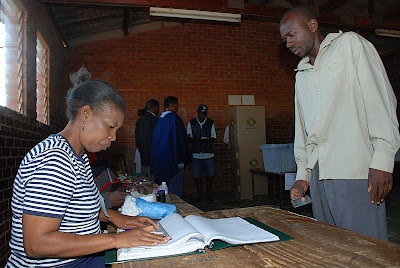
    A Zimbabwe voter gets his name checked (manually) against the voters' roll. The process has opened the door to cheating by parties and there is no one worried about the loopholes at all. Notice that the voter is holding his identity card and the harassed polling officer has to simply check to make sure the name is on the roll. 


    Harare, Zimbabwe, 24 November 2009


    There are the beatings. And the intimidation.


    Everyone knows this is how Mugabe rigs elections to get elected. But something else has now come to light which should prompt the government to put in place measures that can curb an even more difficult rigging process that is almost impossible to stop right now.


    Here's the deal.


    With more than five million registered voters in Zimbabwe (almost six million), we always get around 3 million people only voting.


    There are also people who are not registered to vote, either because they can prove residence (a house they live in and so on) or are lain lazy to do so.


    Parliament has now been told that these people who are not registered to vote routinely take the identity cards of voters and use them to vote.


    It works like this: a political party pays a legion of people in a particular ward to vote and, because there is no coordination between the polling stations, it is possible for me to vote at one polling station with my ID card, get ink on my finger and then hand my ID card to another person who is not registered to vote, who will then go to the next polling station, pose as I and vote.


    All the officials at the next booth, which is still in my ward, are asked to do is check that the name on the ID is on the voters' roll for the ward/constituency. My name would be found there and even though I have already voted, the person presenting the ID can go in and vote again using my name and ID.


    Zimbabwean voters will tell you that officials never have the time to really check the photo and unless you are so daft that you use a female ID card when you are male, you will almost certainly never be caught.


    Elections are so important because they decide the fate of our nation for the following five years and no expense should be too big to ensure that all forms of cheating are eradicated.


    It should be a constitutional requirement that all polling stations in any one ward/constituency be linked electronically and that once one has voted, their name is marked as such in the system. Should that ID show up at the next polling station, looking up the name in the voters roll will also bring up whether or not the person has already voted that day at a different polling station in the same ward/constituency.


    It is something that should be given serious thought.


    Yet no one, except one member of parliament, is worried about this at all. They want to cry foul later on when Mugabe rides into office again on the basis of an inexplicable and fraudulent win.


    BACK TO FRONT PAGE FOR LATEST ZIMBABWE NEWS


    PREVIOUS ARTICLE: "Mugabe Forever" - Zimbabwe War Veterans


    more
  • "Mugabe Forever" - Zimbabwe War Veterans

    Joseph Chinotimba (above), the so-called Commander of Farm Invasions and his band of Ware Veterans have now come out in opposition to God and Fate, declaring that Mugabe should be president of Zimbabwe "forever and ever", basically declaring the Zimbabwean dictator immortal. This shaking of spears comes ahead of ZANU PF's Congress in December this year, at which Mugabe is already guaranteed continued leadership. 


    Harare, Zimbabwe 24 November 2009


    The Zimbabwe War Veterans Association, a mainstay of Mugabe's support base, has come out in support of him and other leaders nominated by ZANU PF provinces to the party's so-called Presidium.


    Joseph Chinotimba, he of straw suits and hats, self-styled Commander of Farm Invasions, issued a statement yesterday saying he and his fellow "freedom fighters" are behind Mugabe "forever and ever."


    We will have to see what God says about that.


    The semi-literate statement from Chinotimba says:


    "As war veterans, we are on the record of saying there is no vacancy on the post of the President and First Secretary of the party. We are happy that our able and God given leader Cde (meaning Comrade) Robert Mugabe was overwhelmingly nominated by all the provinces and we will support him for ever and ever."


    Meantime, a revolt is brewing in ZANU PF after Manicaland province also stated yesterday that it still stands by its choice of Didymus Mutasa for the post of National Chairman of the Ruining Party (ZANU PF).


    I told you last week that Basil Nyabadza, the Manicaland Chairman for ZANU PF, used the church service at the burial of Didymus Mutasa's son to lament the fact that there was no son of the province (Manicaland) in the ZANU PF Presidium.


    Yesterday, he was fuming again, contradicting himself. First, he says it is high time that the posts in Zimbabwe's long-ruling party be given out "on merit" and not on the basis of region or tribe. Yet he goes on to say "for a long time, Manicaland has had no presence in the Presidium."


    So, just being from Manicaland is "merit?"

    Perhaps it means there are no people with merit from Manicaland in ZANU PF and that is why the party has not nominated anyone from there. The ZANU PF leaders in this province need to start working on their leaders from the area to get them to be truly loved by the people and then they can make demands.


    This province of Zimbabwe, in which Marange diamonds are now found, has seen terrible violence in the past and it is down to two men from that area: Didymus Mutasa and Patrick Chinamasa (now Minister of Justice, with Mutasa being Minister in Charge of Mugabe's Spooks).


    The ZANU PF Provincial chairman and his people now want that same Didymus Mutasa elevated to the position of National Chairman. Does he think that the people of Manicaland (which should now be the richest province in Zimbabwe but is being looted left right and centre) will actually turn around and vote for ZANU PF when it elevates such a man to high national office.


    Mutasa is hated in his own home province because of what he has done. He will bring no clout to the presidium. Instead, he will being disrepute. But this has never bothered the party of Mugabe. They believe Zimbabwe is their own property, which they can smash if they so wish, and no one has a right to say anything about it.


    Still, we now know that War Veterans, at least, think that Mugabe is immortal and should be supported "forever and ever".


    BACK TO FRONT PAGE FOR LATEST ZIMBABWE NEWS


    NEXT ARTICLE: Exposed: How Zimbabwe Elections Are Rigged


    PREVIOUS ARTICLE: In Zimbabwe Five Die As Cholera Returns


    more

Search The Entire Web

Entrecard Blog Of The Day

BECOME A MEMBER, JOIN HERE

FOLLOW THIS BLOG ON FACEBOOK

Blog Archive

Harare Weather

My Favorites